
Is faux fur warm? Yes, and often as warm as a good wool coat. But the warmth doesn’t come from the fibre. It comes from still air trapped between the strands. Dense pile and a lining that blocks the wind make a warm coat, while sparse pile on a bare backing lets the cold straight through, however thick it looks.
Below, we look at what really insulates, the weak spot to watch for, four things to check when you choose a winter coat, and how faux fur compares with a puffer jacket and a wool coat.
What insulates: air, not fibre
Every fibre, animal or synthetic, conducts heat. It’s air that insulates, as long as it isn’t moving. Fur works like a layer of trapped air: the more strands there are and the closer together they sit, the more still air they hold against your body.
Density matters more than length. Long but sparse pile parts at the slightest movement and lets fresh air in. Medium-length pile that’s very dense stays put.
Short pile, no lining
Not much air trapped, and the knitted backing lets the wind through. One for autumn and spring.
Long pile, no lining
Plenty of air trapped when you’re still. In a strong wind, though, cold air still gets through the backing.
Dense pile, quilted lining
Air stays still in the pile and the lining stops the wind. This is how coats for serious cold are made.
The weak spot: the backing
Real fur grows out of skin, which is airtight. Faux fur is attached to a knitted or woven backing that lets air through. When you’re standing still and there’s no wind, the difference is small. In a strong wind, cold air blows through unlined faux fur and pushes the warm air out of the pile.
That’s why the lining matters as much as the pile. A satin lining already blocks some of the wind. A quilted lining blocks almost all of it and adds its own layer of insulation.
Four things that make faux fur warm
1. Pile density. Part the pile with your fingers. If you can see a lot of backing straight away, the pile is sparse. On dense faux fur, you have to dig to see the base.
2. The lining. Quilted for serious cold, satin for winter in town, none at all for autumn and spring. Look at photos of the inside and check the composition when it’s given.
3. Coat length. A coat that covers your hips and upper thighs keeps more of you warm and closes off your lower back. A short jacket leaves a gap the wind rushes into as soon as you bend over.
4. Collar and fastening. A coat that hangs open, with no buttons or fastening, lets air in with every step. A high collar, a hood and a fastening that goes all the way up often do more for warmth than a few extra millimetres of pile.
Faux fur vs puffer jacket vs wool coat
| In general | Lined faux fur | Puffer jacket | Wool coat |
|---|---|---|---|
| Warmth when standing still | Good | Very good | Good |
| Wind resistance | Good if lined | Good | Average |
| In the rain | Copes with a shower, air dries | Depends on the outer fabric | Soaks up water and gets heavy |
| Weight | Medium to heavy | Light | Heavy |
| Look | Dressy or dramatic | Sporty | Classic |
In dry, bitter cold, a long lined faux fur coat holds its own. In wet, windy weather, in the mountains or when you’re on the move, a puffer is still the better choice.
Faux fur in rain and snow
Synthetic fibres absorb hardly any water. A shower or snow wets the surface of the pile, which insulates less while it’s damp, but the coat won’t be damaged. When you get in, shake it, hang it up away from the radiator and brush it once it’s dry. For more, see how to wash and dry faux fur.
Our coats for serious cold
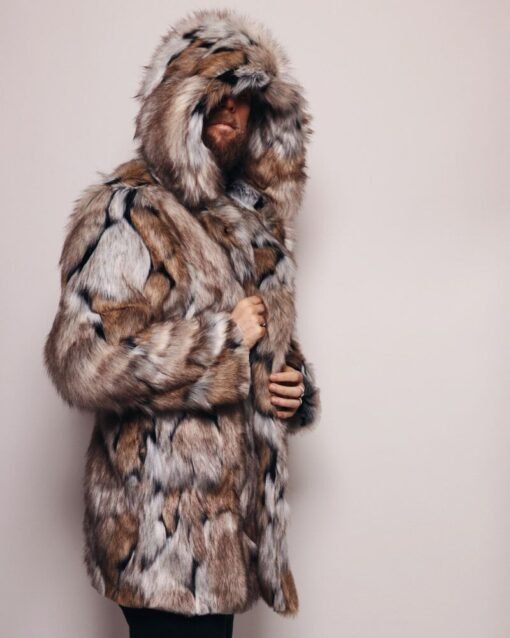
Long, hooded and fastening right up to the neck, these are the coats in our range that tick all four boxes.
-

Women’s grey wolf hooded faux fur coat
- Sizes
- S-XXL
Select options This product has multiple variants. The options may be chosen on the product page -
Women’s dark grey wolf hooded faux fur coat
- Sizes
- XXS-XXL
Select options This product has multiple variants. The options may be chosen on the product page -
Women’s black wolf hood coat in faux fur
- Sizes
- S-XXL
Select options This product has multiple variants. The options may be chosen on the product page -
Men’s wolverine hooded faux fur coat
- Sizes
- S-XXL
Select options This product has multiple variants. The options may be chosen on the product page -
Men’s grey wolf faux fur coat with eared hood
- Sizes
- S-XXL
Select options This product has multiple variants. The options may be chosen on the product page -

Men’s Far North long silver-grey faux fur coat
- Sizes
- XS-3XL
Select options This product has multiple variants. The options may be chosen on the product page




Teddy coats for winter in town
Teddy, with its short curly pile, holds on to air well when you’re not moving and is easy to wear every day. For cold days, choose one with a hood or a high collar.
-
Men’s camel teddy jacket with shirt collar
- Sizes
- S-XXL
Select options This product has multiple variants. The options may be chosen on the product page -
Men’s black teddy fleece jacket
- Sizes
- S-XXL
Select options This product has multiple variants. The options may be chosen on the product page -

Women’s mustard hooded teddy fur jacket
- Sizes
- S-XXL
Select options This product has multiple variants. The options may be chosen on the product page -
Women’s black hooded teddy jacket with open front
- Sizes
- S-XXL
Select options This product has multiple variants. The options may be chosen on the product page -
Women’s hooded teddy fur jacket with zip
- Sizes
- S-XXL
Select options This product has multiple variants. The options may be chosen on the product page -

Women’s hooded teddy jacket in cinnamon
- Sizes
- S-XXL
Select options This product has multiple variants. The options may be chosen on the product page


See our guides on how to wear a teddy coat and men’s teddy jackets.
Finishing off your outfit
In an open coat, your neck is the first place to feel the cold. A hooded scarf closes that gap without changing coats, and a trapper hat keeps your ears warm. Under the coat, a fine wool jumper does a better job than a chunky cotton one, which holds on to sweat.
FAQs
Is faux fur as warm as real fur?
When you’re still and there’s no wind, there’s little difference. In a strong wind, real fur blocks it better because it grows out of airtight skin. Lined faux fur makes up for most of that.
Why am I cold in my faux fur coat?
Usually because the wind is getting through an unlined backing, or because the coat is open at the neck. Do it up to the top, add a scarf, and choose a lined coat next winter.
Is teddy warm?
Yes, for autumn and winter in town, because the curls trap air. In bitter cold or a strong wind, go for a lined, hooded style.
Can faux fur get wet?
Yes. Synthetic fibres absorb very little water and the coat won’t be damaged. Let it dry in the air, away from any heat, then brush it.
Faux fur or a puffer jacket for winter?
For town in cold, dry weather, a long lined faux fur coat. For the mountains, rain or exercise, a puffer.
Further reading
To tell the materials apart, read real or faux fur: six tests. For length, see long faux fur coats, and for hoods, hooded faux fur coats and jackets.
Shop women’s faux fur coats, men’s faux fur coats and teddy coats and jackets.


