
The animals used for fur in fashion are mostly mink, fox, rabbit, chinchilla, sable, raccoon and sheep. You can recognise each one by the length of its fur, how dense it is, its sheen and its markings, and that’s exactly what faux fur sets out to copy.
For some species, imitation is now the only option. Leopard, tiger and ocelot are protected by CITES, also known as the Washington Convention, which bans international trade in them. Below is a list of the main animals used for fur, then their faux fur versions, species by species, with the matching styles from our range.
Animals used for fur: the list
| Animal | Fur | Traditional use | Trade status |
|---|---|---|---|
| Mink | Short, very dense, glossy | Coats, stoles | Farming banned in France under a 2021 law |
| Red, silver and Arctic fox | Long, full, light | Collars, coats, stoles | Farming banned in France, imports allowed |
| Rabbit | Short, very soft | Linings, collars, pompoms | Domestic species, trade allowed |
| Chinchilla | Very dense, slate grey | High-end coats | Trade allowed |
| Sable | Long, silky, deep brown | Coats, trapper hats | Imports regulated, one of the most expensive furs |
| Raccoon, raccoon dog | Long, grizzled, black-tipped | Hood trims, pompoms | Imports regulated |
| Coyote | Long, thick, greyish beige | Parka hood trims | Imports regulated |
| Beaver, muskrat | Dense, often sheared | Hats, linings | Imports regulated |
| Sheep, lamb | Curly or tightly curled | Sheepskin, astrakhan | Domestic species, trade allowed |
| Lynx | Long, spotted belly | Coats | Protected in Europe, trade regulated |
| Leopard, tiger, jaguar, ocelot | Short, spotted or striped | Coats until the 1970s | International trade banned (CITES Appendix I) |
| Seal | Very short, glossy | Boots, coats | Trade banned in the EU since 2010, with some exceptions |
| Cat, dog | Varies | Linings, trims | Trade banned in the EU since the end of 2008 |
‘Imports regulated’ means the EU only accepts skins of these species from countries that meet trapping standards. Selling real fur is still legal in France for any species these bans don’t cover. To tell real fur from faux, see how to tell if fur is real: 6 tests.
How faux fur copies an animal
A convincing imitation gets four things right.
Two lengths of hair. Real fur has short underfur and longer guard hairs. Good imitations mix fibres of two lengths and two thicknesses.
Tipped ends. On wolf, silver fox and raccoon, the tip of each hair is lighter or darker than the base. Faux fur gets the same effect with fibres dyed in a gradient.
Markings. Leopard spots and tiger stripes are either printed onto the pile or woven into the backing with fibres in different colours. Woven-in markings last longer.
Shearing. Mink and rabbit have a very short pile. Their imitations are sheared short and often polished to bring back the sheen.
Wolf
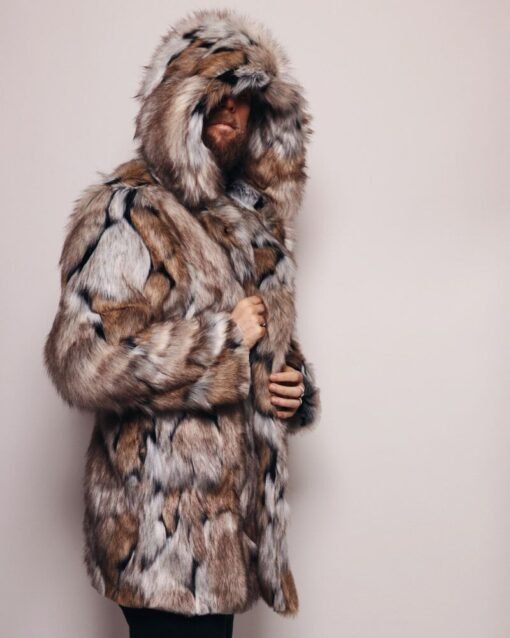
In faux fur, wolf means a long, mixed pile, from pale grey to almost black, with contrasting tips. Wolves are still protected in Europe, even though their status was downgraded in 2025 from ‘strictly protected’ to ‘protected’, so faux fur is the easy way to wear this look. It’s even developed a style of its own, often with a hood.
-

Women’s grey wolf hooded faux fur coat
- Sizes
- S-XXL
Select options This product has multiple variants. The options may be chosen on the product page -
Women’s dark grey wolf hooded faux fur coat
- Sizes
- XXS-XXL
Select options This product has multiple variants. The options may be chosen on the product page -
Men’s grey wolf faux fur coat with eared hood
- Sizes
- S-XXL
Select options This product has multiple variants. The options may be chosen on the product page -
Men’s black wolf hooded faux fur coat
- Sizes
- S-XXL
Select options This product has multiple variants. The options may be chosen on the product page -
Men’s black wolf faux fur coat with turn-down collar
- Sizes
- S-XXL
Select options This product has multiple variants. The options may be chosen on the product page -
Women’s layered faux fur cropped jacket in five colours
- Sizes
- S-XXL
Select options This product has multiple variants. The options may be chosen on the product page


See our full range of wolf faux fur coats and jackets. For what the animal stands for, read the wolf as a spirit animal.
Fox
Long, light, very full pile. Red fox is orange with dark tips, silver fox is black with white tips, and Arctic fox is white or bluish grey. It’s the fur you see on big long coats and oversized collars.
Real fox coats are still sold in France, where farming non-domestic species for fur is banned but imports are allowed. White and silver fox are easy to imitate, because their contrasting tips can be recreated with fibres dyed in a gradient. You’ll find fox faux fur on long coats, gilets and simple hats.
-
Women’s long red fox faux fur coat
- Sizes
- S-XXL
Select options This product has multiple variants. The options may be chosen on the product page -
Women’s white fox hooded faux fur coat
- Sizes
- S-XXL
Select options This product has multiple variants. The options may be chosen on the product page -
Men’s long tawny fox faux fur coat
- Sizes
- S-4XL
Select options This product has multiple variants. The options may be chosen on the product page -
Men’s long black fox faux fur coat
- Sizes
- S-4XL
Select options This product has multiple variants. The options may be chosen on the product page -
Women’s white fox faux fur gilet
- Sizes
- S-3XL
Select options This product has multiple variants. The options may be chosen on the product page -
Fox faux fur Cossack hat
€29.99Select options This product has multiple variants. The options may be chosen on the product page


-
Women’s grey silver fox faux fur jacket
- Sizes
- S-3XL
Select options This product has multiple variants. The options may be chosen on the product page -
Women’s silver fox faux fur cropped jacket
- Sizes
- S-XXL
Select options This product has multiple variants. The options may be chosen on the product page -


Big cats: leopard, panther, ocelot and lynx
Leopard, panther and ocelot are listed in CITES Appendix I, which bans international trade in them, and lynx is protected in Europe. So these furs now only exist as imitations, and the markings are what count: rosettes for leopard, solid elongated spots for ocelot, plain black for panther and a spotted belly for lynx.
-
Women’s leopard print faux fur coat
- Sizes
- S-XXL
Select options This product has multiple variants. The options may be chosen on the product page -
Women’s leopard print hooded faux fur coat
- Sizes
- S-XXL
Select options This product has multiple variants. The options may be chosen on the product page -
Women’s ocelot hooded faux fur coat
- Sizes
- XS-XL
Select options This product has multiple variants. The options may be chosen on the product page -
Men’s black panther faux fur coat
- Sizes
- S-XXL
Select options This product has multiple variants. The options may be chosen on the product page -
Men’s long snow leopard faux fur coat
- Sizes
- S-6XL
Select options This product has multiple variants. The options may be chosen on the product page -
Men’s lynx faux fur coat
- Sizes
- S-XXL
Select options This product has multiple variants. The options may be chosen on the product page


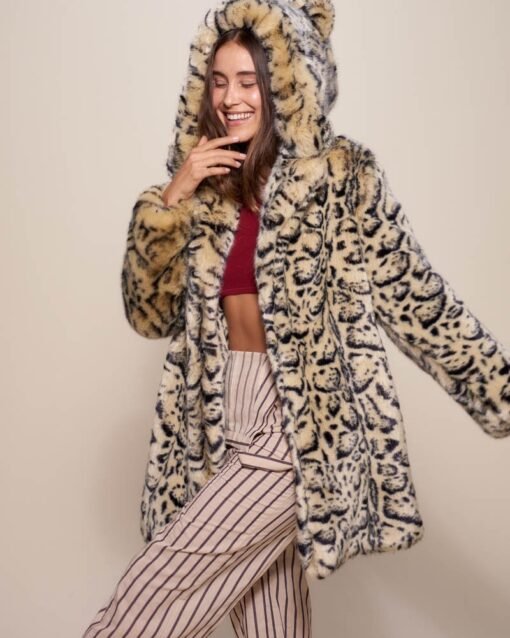


To wear animal print without overdoing it, our guide to men’s faux fur coats has combinations that work.
Rabbit: rabbit faux fur coats and jackets
Rabbit is the most common real fur, and the cheapest. It’s a domestic species, so farming it is still allowed in France, and some of the skins come from rabbits farmed for meat.
The fur is short, very soft and matt. Its weakness is well known. The skin is thin and the hair comes out easily, so a rabbit fur coat sheds and wears quickly where it rubs, at the cuffs and under the arms. Like any real fur, it can’t be washed in water.
Rabbit faux fur copies the short, matt pile, in short jackets and bombers. It can be washed at 30°C.
-
Camel rabbit faux fur cropped jacket
- Sizes
- S-XXL
Select options This product has multiple variants. The options may be chosen on the product page -

Women’s short black faux fur jacket
- Sizes
- S-XXL
Select options This product has multiple variants. The options may be chosen on the product page -
Women’s white rabbit faux fur jacket
- Sizes
- S-3XL
Select options This product has multiple variants. The options may be chosen on the product page


Mink: short, glossy fur
Mink fur is short, very dense and glossy. It was the status coat of the 20th century, long for women and less often for men. In France, farming mink for fur has been banned since the law of 30 November 2021, so any real mink coats you see today are imported or second-hand.
Mink and rabbit are the two short-pile furs, mink dense and glossy, rabbit softer and more matt. Their imitations are the most understated of all. From a distance, they pass for a thick wool coat.
For men, a long mink faux fur coat goes over a suit or a roll neck. It’s an overcoat, not a trapper coat. The same pile comes in bags and throws too.
-
Men’s long mink faux fur coat
- Sizes
- S-5XL
Select options This product has multiple variants. The options may be chosen on the product page -
Mink faux fur handbag with short handle
€49.99Select options This product has multiple variants. The options may be chosen on the product page -


Wolverine, panda and bear
The wolverine lives in the far north. Its fur is known for not holding frost, which is why Arctic peoples have traditionally used it to trim their hoods. Panda has never been traded for fur, and bear is rare in fashion, apart from the bearskin caps worn by the British Guards. Imitations of all three play on markings and bulk, with a deliberately plush, soft-toy feel.
-
Men’s wolverine hooded faux fur coat
- Sizes
- S-XXL
Select options This product has multiple variants. The options may be chosen on the product page -
Women’s wolverine faux fur coat
- Sizes
- S-3XL
Select options This product has multiple variants. The options may be chosen on the product page -
Women’s hooded wolverine faux fur coat
- Sizes
- XS-XXL
Select options This product has multiple variants. The options may be chosen on the product page -
Men’s panda faux fur jacket with hood
- Sizes
- S-XXL
Select options This product has multiple variants. The options may be chosen on the product page -
Women’s panda hooded faux fur coat
- Sizes
- S-XXL
Select options This product has multiple variants. The options may be chosen on the product page -
Men’s black bear faux fur jacket
- Sizes
- S-5XL
Select options This product has multiple variants. The options may be chosen on the product page


Sheep: teddy, bouclé and sherpa
Sheepskin with the wool left on, worn wool side in, gave us shearling. Karakul lamb, with its tight curls, gave us astrakhan. Their faux versions are called teddy, bouclé or sherpa, depending on how long and curly the pile is. See our guides on how to style a teddy coat and men’s teddy jackets.
-
Women’s long double-breasted teddy bear faux fur coat
- Sizes
- XS-L
Select options This product has multiple variants. The options may be chosen on the product page -
Women’s long hooded teddy jacket with bear print
- Sizes
- S-XXL
Select options This product has multiple variants. The options may be chosen on the product page -
Women’s chocolate brown teddy jacket with bear print
- Sizes
- S-XXL
Select options This product has multiple variants. The options may be chosen on the product page -
Women’s beige double-breasted teddy jacket
- Sizes
- S-XXL
Select options This product has multiple variants. The options may be chosen on the product page -
Men’s camel teddy jacket with shirt collar
- Sizes
- S-XXL
Select options This product has multiple variants. The options may be chosen on the product page -
Men’s black teddy fur jacket with funnel collar
- Sizes
- M-4XL
Select options This product has multiple variants. The options may be chosen on the product page


FAQs
Which animal has the densest fur?
The sea otter, with up to about 150,000 hairs per square centimetre, a record among mammals. Of the species used in fashion, chinchilla and mink have the densest fur.
Which furs are banned in France?
Trading cat, dog and seal fur is banned across the EU. Species listed in CITES Appendix I, such as leopard and tiger, can’t be traded internationally. And since the law of 30 November 2021, France has banned farming non-domestic species such as mink purely for their fur.
What is sheep’s fur called?
On an adult sheep, it’s sheepskin or shearling. On karakul lamb, with its tight curls, it’s astrakhan. The faux fur versions are called teddy, bouclé or sherpa.
Why copy wolf rather than another animal?
For its long pile with contrasting tips, which gives it lots of depth, and for what it symbolises. Because wolves are protected in Europe, wolf faux fur has developed a style of its own, especially the hooded coat.
Does a rabbit fur coat shed?
Yes, that’s rabbit’s well-known flaw. The skin is thin and the hair comes out where it rubs. Rabbit faux fur mostly sheds loose fibres in the first few weeks. See our guide on faux fur shedding.
Does leopard print faux fur fade?
A printed pattern can fade with washing and sunlight, while a pattern woven into the backing lasts better. Either way, wash it cold and dry it out of direct sunlight.
Further reading
Care: how to wash faux fur. Warmth: is faux fur warm?


