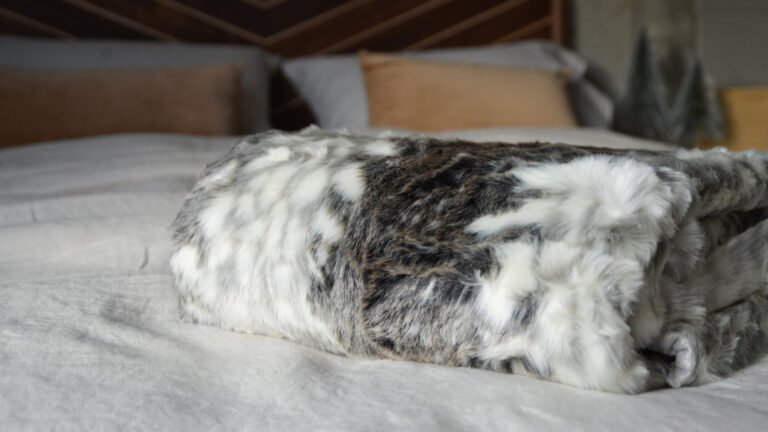
A new faux fur coat sheds loose fibres the first few times you wear it. That’s normal, and it stops. Faux fur shedding that carries on, in clumps or until you can see the backing fabric, points to a fault or to wear.
This guide explains where the loose fibres come from and how to tell normal shedding from a fault. Then it covers what you can do to keep it down, whether it’s a coat, a throw or a length of faux fur fabric you’re sewing.
Why does faux fur shed?
Faux fur is made of synthetic fibres, usually acrylic, modacrylic or polyester, held in a knitted backing fabric. The back of that fabric is then given a thin coating that locks the fibres in at the base. A fibre falls out when the backing isn’t holding it, or has stopped holding it.
Loose fibres from the first few wears
When the fabric is cut and sewn, fibres get sliced along the seams and across the surface of the pile. Nothing holds them any more, so they come off at the first contact: on a black jumper, on a seat, in the delivery bag. It isn’t a fault. A brush and a few wears get rid of them.
Friction
A bag strap, a seatbelt or the back of a car seat always rubs the same spots. The pile breaks there, first at the tips and then further down, so the loss stays in one place: the shoulder, the back, the cuffs or under the arms.
Heat and washing
Synthetic fibres don’t cope well with heat. Water that’s too hot, a tumble dryer, a radiator or an iron makes them frizz, harden and then snap. A fast spin twists the backing fabric and releases fibres it was still holding.
A manufacturing fault
When the coating is too thin or patchy, the backing stops holding anything. Fibres keep coming out in whole clumps and the backing fabric starts to show. No amount of care will fix that.
Normal or faulty: how to tell
| What you see | What it is | What to do |
|---|---|---|
| A few fibres on your clothes in the first few days | Loose fibres from cutting | Shake it, brush it, give it a few wears |
| Shorter or broken pile in one particular spot | Friction | Change bags or shoulders, brush the area |
| Frizzy tips that feel hard | Heat | Can’t be reversed, so trim off the damaged tips |
| Whole clumps, backing fabric showing | Manufacturing fault | Report it to the seller within the returns period |
| Shedding that doesn’t ease after several brushings | Probably a fault | Gently tug a tuft: if it comes out in one piece, it’s the backing |
What to do when faux fur sheds
Shake it outside. Hold it by the shoulders and give it a few firm shakes, so the loose fibres drop before they end up on your clothes.
Brush it dry, in the direction of the pile. A soft-pin brush, like the ones sold for dogs and cats, picks up loose fibres without pulling out the ones still attached. Work in small sections from top to bottom, without pressing down.
Use a lint roller on the clothes you wear underneath, not on the faux fur. On the pile, a roller pulls out healthy fibres and leaves glue behind.
Wash it once, at 30°C maximum. A cold or lukewarm wash with a mild detergent and a low spin takes out the remaining loose fibres in one go. Clean the machine filter afterwards. Our guide on how to wash faux fur has the details.
If it’s a fault, don’t try to treat it. Report it. Take a photo of the visible backing fabric and contact the seller while you’re still within the returns period.
How to stop faux fur from shedding
Store it hanging up, on a wide hanger, in a breathable cotton garment bag. A plastic cover traps moisture, and a crammed wardrobe crushes the pile.
Avoid the same friction every day. Switch the shoulder you carry your bag on, or use a handbag instead. It’s the most common cause of wear on a long-pile coat.
Keep it away from heat. Don’t tumble dry or iron it, and never dry it on a radiator. Wet faux fur should dry flat or on a hanger, in the open air.
Wash it inside out in a mesh bag if the label says it can go in the machine. The pile rubs less against the drum that way.
Brush it once a season, and no more. Brushing too often ends up breaking the very fibres it’s meant to look after.
When a faux fur throw sheds
A faux fur throw often sheds more than a coat in the first few weeks. It has a much larger cut surface, and it spends its life rubbing against a sofa or a bed.
Wash it on its own the first time, without towels or other cotton items that would catch the fibres. Dry it spread out, then shake it outside before you put it back. If fibres stay on the sofa, the upholstery brush on your vacuum cleaner picks them up better than a lint roller. Our guide to the faux fur throw covers sizes and care.
If you sew with faux fur
Faux fur fabric sheds mostly when you cut it. Three habits keep the mess down.
Cut from the back, and only through the backing. Use a craft knife, or the tips of your scissors with the blade slid under the pile, so you don’t slice the fibres. The edges stay full and hardly anything falls.
Vacuum the edges of each cut piece before you sew them together. The sliced fibres come away then, rather than in your sewing machine.
Push the pile inwards before sewing, then use the point of a pin to pick out any fibres caught in the seam. The seam disappears under the pile.
FAQs
How long does new faux fur shed for?
The loose fibres come out within a few wears, at the first brushing or the first wash. If the shedding doesn’t ease after several brushings, it’s no longer normal.
Do hairspray or faux fur shedding sprays work?
No. No spray can stick a fibre back into the backing once it’s come out. Hairspray stiffens the pile, dulls it and attracts dust.
Does the tumble dryer get rid of shedding fibres?
It does, but the heat damages the fibres that are left, leaving frizzy tips and hard pile. Air dry it, then brush.
Does real fur shed too?
Yes. Rabbit is known for it, because the skin is thin and the hair comes away wherever it rubs. See our guide to the animals faux fur imitates.
Does shedding mean the faux fur is poor quality?
Not necessarily. All faux fur sheds loose fibres at first. You judge quality by how dense the pile is and how strong the backing is. Part the pile: you shouldn’t be able to see the backing fabric.
Further reading
Looking after it: how to wash faux fur, how to fluff up flat or dull pile and how to fix a damaged hood.
To tell real fur from faux, try these 6 tests. Shedding shows less on pale colours than on dark ones: see our guides to white and beige and black.