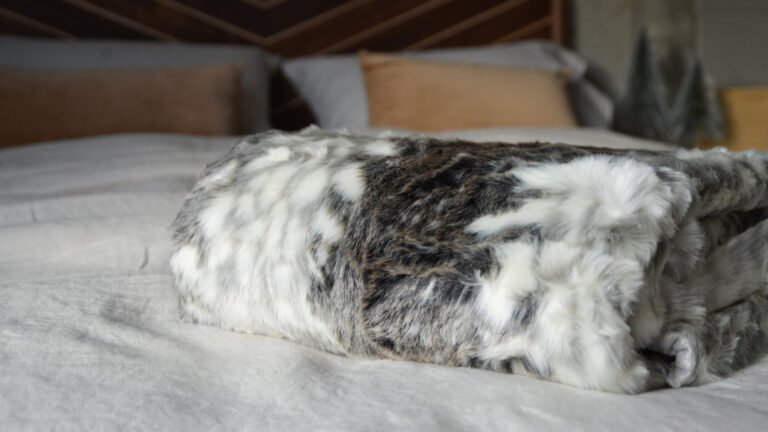
If you want to know how to fluff up faux fur, start by working out why it went flat in the first place. There are three usual reasons, and each needs a different fix. The pile is flattened because it’s been crushed, matted because it’s been rubbed, or dull because it’s dirty. A fourth cause, heat, can’t be undone.
This guide helps you spot the problem, then gives you the method that matches it. Reviving faux fur rarely takes more than an hour, drying included.
Work out what’s wrong before you treat it
New
Straight, parallel fibres that spring back up when you run a hand against the pile.
Flattened
The fibres are intact but lying down, wherever you lean on them: back, seat, hood. Steam brings them back.
Matted
The fibres have tangled into clumps, usually at the back of the neck, the cuffs and under the arms. A brush sorts it out.
Melted
Tips curled, hard and sometimes stuck together, after the tumble dryer, an iron or a radiator. This can’t be fixed.
Run your hand against the pile. If it lifts a little, it’s flattened. If it resists in clumps, it’s matted. If it feels rough and the tips catch, it’s been overheated. If it all lifts but the colour looks greyish, it’s simply dirty.
Flattened pile: steam, then brush
Steam relaxes the fibres, and they set in their new position as they cool. It’s the most effective fix for crushed long pile.
Hang the garment in the bathroom while you have a hot shower, with the door shut, for about ten minutes. Or use a garment steamer held 20 to 30cm away, without ever touching the pile.
Brush while the pile is still warm and damp. Go lightly against the pile first to lift it, then brush with the pile to lay it back down.
Leave it to dry on a wide hanger, in the open air, and don’t touch it. The pile sets as it dries.
A hairdryer on the cool or warm setting can stand in for steam, held at least 20cm away. Never use the hot setting, as it’s the most common cause of melted tips.
Matted pile: untangle it without breaking the fibres
Matting is dealt with dry, one tuft at a time. Use a slicker brush with soft metal pins, the kind sold for dogs, or a wide-tooth comb.
Hold the base of the tuft between two fingers, against the backing fabric. That way the brush pulls against your fingers rather than the backing, so the backing won’t tear.
Start at the tips and work down towards the base in short strokes. Brushing from the base in one go tightens the knot instead of loosening it.
Finish with steam, as you would for flattened pile, to give the untangled patch its bulk back.
Dull pile: a gentle wash
Grey or sticky pile is usually just dirty. Think dust, skin oils around the collar and hood, or too much detergent left over from an earlier wash.
Wash it by hand or in the machine at 30°C maximum, with a little mild liquid detergent and a low spin. Too much detergent weighs the pile down and makes it look dull. Dry it flat on a towel, then brush when the pile is almost dry. Our guide on how to wash faux fur goes through it garment by garment.
Fixing faux fur: two different problems
When people ask how to fix faux fur, they usually mean one of two things.
Getting pile that sticks out in all directions back into line. That’s pile flattened or matted in places. Steam it, brush it the way the pile runs, then let it dry without touching it. The pile keeps whatever direction it had when it cooled.
Stopping fibres from falling out. That’s a separate issue, and it comes down to how strong the backing fabric is. We cover it in our guide to faux fur shedding.
What can’t be saved
Melted pile. A synthetic fibre that’s been overheated stays curled and hard. On a small patch, you can snip off the damaged tips with scissors, matching the length of the pile around them. Over a large area, the garment won’t look the same again.
Pile worn down to the backing. Where you can see the backing fabric, there are no fibres left to revive. A hood or collar in that state needs replacing, so see our guide to fixing a damaged faux fur hood.
FAQs
Can you use hair straighteners or an iron on faux fur?
No. Synthetic fibres melt on contact with a hot plate, and the pile stays hard and frizzy in that spot.
Does putting faux fur in the freezer help untangle it?
There’s no evidence that it does. Cold doesn’t loosen tangled fibres. Brushing tuft by tuft while you hold the base is safer.
How do you fluff up curly teddy?
Don’t brush it right through, because a brush pulls out the curls and leaves the pile flat and fuzzy, like cotton wool. Steam it, then separate the curls with your fingertips.
How often should you brush faux fur?
When the pile goes flat, and when you put it away at the end of the season. Brushing too often breaks the fibres.
Should you take it to the dry cleaner’s?
You don’t need to just to revive the pile. If you do, tell them it’s faux fur and ask for a treatment without heat.
Further reading
Care guides: washing faux fur, faux fur that sheds and cleaning teddy.
Teddy has a short, dense pile, so it bounces back more easily than long pile: browse our teddy coats and jackets. A white that’s gone dingy doesn’t recover the same way as a black that’s turned grey, as our guide to white and beige faux fur explains.