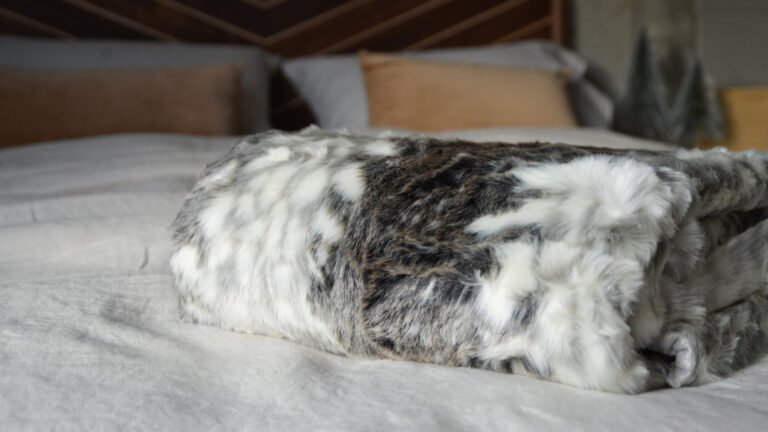
Faux fur, also sold as synthetic or fake fur, is a pile fabric made to look like an animal’s fur. So what is faux fur made of? Today, polyester, acrylic or modacrylic, all fibres made from oil. It started out differently: the first version appeared in 1929, using alpaca hair fixed to a fabric backing, and it only went synthetic in the mid-1950s, when acrylic fibres came along.
Below, we look at where it came from, what goes into it, what it does better than animal fur, and the drawbacks worth knowing about before you buy.
Animal fur, and why anyone wanted to copy it
Fur is the dense hair that grows on certain mammals. The word also covers the tanned skin with the hair left on, and the clothes made from it. On the animal, its main job is to control body temperature, because still air trapped between the hairs keeps the cold out.
People first wore it for protection, but it soon became a sign of rank. In the Middle Ages, sumptuary laws kept some furs, ermine among them, for the nobility. In the 20th century, the mink coat became the film world’s symbol of wealth.
That prestige came with a problem. Fur was expensive, and the most sought-after species were scarce. The first fur farms opened in North America in the late 19th century to keep up with demand. Imitation fur grew out of the same need, and answered it a different way.
From alpaca to acrylic in three stages
1929. The first faux furs were made from the hair of the alpaca, a South American camelid, fixed to a fabric backing. They came in grey or brown and didn’t fool anyone, but they were warm and cheap.
The 1940s. Better textile manufacturing made the pile denser and helped it keep its shape.
The mid-1950s. Acrylic fibres took over from alpaca. They were lighter and easier to dye and texture, and they gave us faux fur as we know it now. Modacrylic, a type of acrylic, came later. It’s softer to the touch and doesn’t catch fire as easily.
What faux fur is made of today
There are two parts: the fibres that make up the pile, and a knitted or woven backing that holds them in place.
The fibres are polyester, acrylic or modacrylic, used on their own or blended. All three are synthetics made by the petrochemical industry. Polyester is the norm in everyday clothes, teddy especially, while modacrylic turns up mostly in high-end faux fur.
The pile is then cut to length, polished and heat-set, which is what makes it hang the way it does. It’s also why heat damages it. Go above the temperature it was set at and the pile twists and never recovers. For the whole process, see how faux fur is made.
What it does well
No animal-derived materials. No farming, no slaughter and no tanned skins. That’s why most people buy it.
The price. A faux fur coat costs a fraction of what a mink or fox coat does.
You can wash it at home. Depending on the care label, faux fur can be hand washed or machine washed at 30°C. Real fur never goes near water and has to be taken to a furrier.
Any colour you like. The fibre takes any dye, including shades no animal has ever had.
It copes with rain. Synthetic fibres soak up very little water, so a shower won’t harm it. A wet animal skin, on the other hand, can go stiff as it dries.
The drawbacks to know before you buy
It’s made from oil. The fibres are plastics. Choosing faux fur spares animals, but it isn’t free of impact.
It doesn’t biodegrade. A synthetic fibre that’s thrown away lasts for centuries, and fragments of it stay in the environment.
It sheds microfibres in the wash. So does every synthetic fabric, fleece included.
Three habits cut this down. Wash it less often, and brush and air it in between. Wash it cold, in a mesh bag, on a low spin, which also means less wear on the pile. Above all, keep it for years, because faux fur that’s looked after lasts several winters. When it’s finished, take it to a clothes bank rather than putting it in the bin.
A more sustainable wardrobe has less to do with the fabric than with how long you keep things: buy less, choose cuts that won’t date, and look after them. Our guide on how to wash faux fur shows you how.
Animal fur in France today
Since the law of 30 November 2021, France has banned farming non-domestic species, such as American mink, purely for their fur. The law only covers farming. Selling fur is still allowed.
In fashion, several big houses have stopped using animal fur, Chanel among them at the end of 2018. If you like how a real fur coat looks but not the questions that come with it, you have three options: faux fur, vintage or second-hand.
To tell them apart at a glance, see our guide on how to tell if fur is real, in 6 tests. For the animals faux fur copies, and the rules on trading their fur, read animals used for fur, the full list.
FAQs
What do you call fur made from synthetic fibres?
Faux fur, fake fur, synthetic fur and imitation fur all mean the same thing. The fibres themselves are polyester, acrylic or modacrylic. When the pile is short and curly, it’s called teddy, borg or sherpa.
When was faux fur invented?
In 1929, using alpaca hair. The synthetic version, made with acrylic fibres, dates from the mid-1950s.
Is faux fur vegan?
There’s nothing animal-derived in it: the pile is synthetic, the backing is fabric and the lining is synthetic. The only thing to check on the label is the finishing, such as buttons or trims.
Is faux fur bad for the environment?
Strictly speaking, it isn’t eco-friendly. It avoids farming and slaughter, but it’s made from oil, it doesn’t biodegrade and it sheds microfibres in the wash. Its footprint depends mostly on how many winters you wear it.
Do people still wear fur in Paris?
Yes, but things have changed. France has banned farming non-domestic species for their fur since the law of 30 November 2021, and several Paris fashion houses no longer work with animal fur. Faux fur gives you the same look without those questions.
Is faux fur as warm as real fur?
In still air, there’s not much in it. In a strong wind, real fur blocks it better, because it grows out of an airtight skin. A lined faux fur coat makes up for that. More on this in is faux fur warm?
Further reading
Choosing a coat or jacket: how to choose a women’s faux fur coat, how to wear a men’s faux fur coat, women’s teddy jackets.
Shop by category: women’s coats, men’s coats, women’s jackets.